
Band D in Bromley is £2,140.04 for 2026/27, Band A £1,426.69, Band E £2,615.61. Every band, the 25% single person discount and how to challenge your band.
Bromley council tax for 2026/27 runs from £1,426.69 at Band A to £4,280.08 at Band H, with Band D at £2,140.04. A London bill has only two parts, the borough’s own charge and the Mayor of London’s precept, and there are no parish charges, so one set of figures covers the whole borough.
Overview
- Band D 2026/27: £2,140.04 a year (Bromley £1,629.53, Greater London Authority £510.51). Band A £1,426.69, Band H £4,280.08.
- Rise this year: 4.8 per cent on bills (Bromley share 4.99 per cent, GLA share 4.10 per cent).
- Find your band: GOV.UK postcode checker. Challenge it free through the Valuation Office Agency, not the council.
- £100 Household Energy Payment: homes in bands A to D get £100 from January 2027. Direct debit payers are paid automatically; others will be invited to apply by the council.
- Live alone? Claim 25 per cent off with the single person discount form.
- Pay or manage your account: pay online, sign in to MyBromley, or ring the 24-hour payment line on 0300 003 0089.
Bromley council tax by band, 2026/27
The figures below are the full annual charge for each band, taken from the council’s own guide to your council tax 2026/27. There are no parish precepts in Bromley, so unlike a shire district there is only one set of numbers for the whole borough.
| Band | Bromley | GLA precept | Total for the year |
|---|---|---|---|
| A | £1,086.35 | £340.34 | £1,426.69 |
| B | £1,267.41 | £397.06 | £1,664.47 |
| C | £1,448.47 | £453.79 | £1,902.26 |
| D | £1,629.53 | £510.51 | £2,140.04 |
| E | £1,991.65 | £623.96 | £2,615.61 |
| F | £2,353.77 | £737.40 | £3,091.17 |
| G | £2,715.88 | £850.85 | £3,566.73 |
| H | £3,259.06 | £1,021.02 | £4,280.08 |
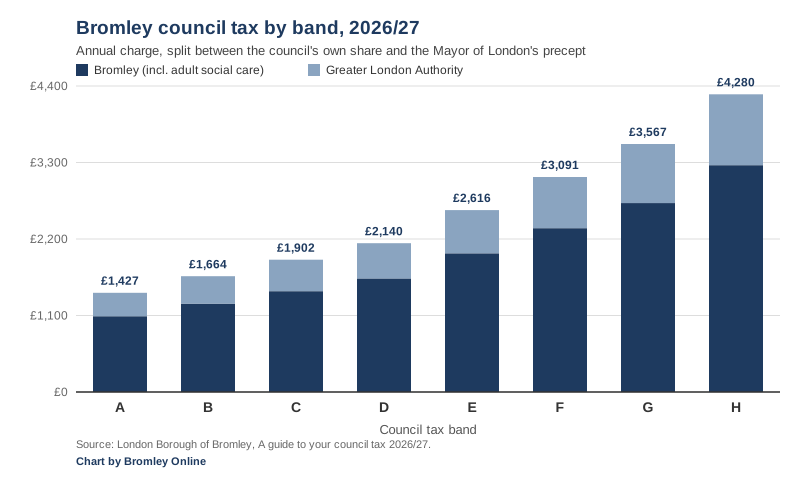
What it means for you: the ratios between bands are set in law and are the same everywhere in England, so a Band A home always pays two thirds of Band D and a Band H home always pays exactly double it. In cash terms, moving up one band from C to D costs roughly £238 a year in Bromley, and the gap between the cheapest and dearest band is £2,853.39.
The two parts of a London bill
Bromley collects the whole amount, but it does not keep the whole amount.
The Bromley share is by far the larger part, £1,629.53 at Band D, or about 76 pence in every pound. It funds the services people think of as local: bin collections, parking and highways, planning, libraries, parks, and by far the biggest single item, adult and children’s social care. For 2026/27 the council raised its own share by 4.99 per cent, of which 2 percentage points is the ring-fenced adult social care precept, a separate charge central government allows councils to levy specifically for care costs. The council publishes a note on how the adult social care precept is calculated.
The GLA precept is the other £510.51 at Band D, about 24 pence in the pound. This is not Bromley’s money and Bromley does not decide it. It is set by the Mayor of London and the Greater London Authority, and it funds the Metropolitan Police, the London Fire Brigade, Transport for London and the GLA itself. Every London borough collects it on the Mayor’s behalf at the same Band D rate, so this element is identical whether you live in Bromley, Bexley or Barnet. For 2026/27 it went up by 4.10 per cent.
Put together, the two increases produce an overall rise of 4.78 per cent, which appears on bills as 4.8 per cent because of rounding.
What the bands actually mean
Every home in England sits in one of eight bands, and the band is not based on what your house is worth now. It is based on what the property would have sold for on the open market on 1 April 1991, a valuation date that has never been updated since council tax began in 1993. Bandings are decided by the District Valuer at HM Revenue and Customs, not by the council (council tax valuation bands).
| Band | 1991 property value |
|---|---|
| A | Up to and including £40,000 |
| B | £40,001 to £52,000 |
| C | £52,001 to £68,000 |
| D | £68,001 to £88,000 |
| E | £88,001 to £120,000 |
| F | £120,001 to £160,000 |
| G | £160,001 to £320,000 |
| H | More than £320,000 |
Because the valuation date is more than thirty years old, Band G is unusually wide, covering everything from £160,001 to £320,000 in 1991 money, which is why a great many Bromley homes that feel very different from one another sit in the same band.
How to check and challenge your band
To find your band, search your postcode on the GOV.UK council tax band checker. It also shows your neighbours’ bands, which matters: if similar homes on your street are banded lower than yours, that is the strongest evidence you have for a challenge.
Banding queries go to the Valuation Office Agency, not to Bromley Council, and the council says so plainly. The grounds for a challenge are restricted, and you should be clear about the risk before you start: the VOA can lower your band, leave it alone, or raise it. You do not need to pay a company to do this. The free route is the challenge your council tax band service on GOV.UK.
Billing questions, by contrast, are the council’s. The first instalment of the year falls on 1 April, then payments are due on the 1st of each month; direct debits can be taken on the 1st, 15th or 24th. If you pay any other way, pay five days before the due date. You can pay online, by the automated phone line on 0300 003 0089 (have your 8-digit reference ready), by standing order, by post to P.O. Box 126, Bromley, BR1 3ZT, or at the payment kiosk in Penge Library, which takes cards and cash but not cheques. Changes of address and bills are handled through a MyBromley account (paying your council tax).
The £100 Household Energy Payment
The Autumn Budget on 28 October brought in a one-off £100 payment for households in bands A to D, paid from January 2027. In Bromley that covers every home paying up to £2,140.04 a year. You qualify if you are liable for council tax on the property and live there as your main home. Second homes and empty properties do not qualify.
If you pay by direct debit you do not need to do anything: the money goes straight into your bank account. If you pay another way, Bromley Council will invite you to apply. The government warns that nobody other than your council should contact you about claiming it. Homes in bands E to H cannot get the £100, but councils are getting a separate fund for discretionary help with energy bills, with local rules still to be published (what the Autumn Budget 2026 means for your energy bills).
Discounts, exemptions and premiums
Plenty of Bromley households pay more than they need to because they never claim.
The single person discount takes 25 per cent off. Bromley explains the logic behind it more clearly than most councils: the bill is treated as 50 per cent property tax and 50 per cent residential tax, and the residential half assumes two adults, so one adult means the residential element drops to 25 per cent. It does not apply to empty properties, and you must tell the council straight away if your circumstances change, or you will end up repaying an overpayment (single person discount).
Certain people are disregarded when the council counts the adults in a home. If everyone but one resident is disregarded you still get 25 per cent off, and if every resident is disregarded the discount is 50 per cent. The categories include full time students, student nurses, apprentices and people on youth training, spouses of overseas students, people whose main home is a hospital, care home, hospice or hostel, people who are severely mentally impaired, 18 and 19 year olds at or just out of school, low paid care workers living with the person they care for, carers looking after someone with a disability who is not a spouse or a child under 18, members of religious communities, and people in prison other than for non-payment.
There is also a disabled band reduction where a property has been adapted to meet the needs of a disabled resident. On low incomes, working-age households can claim the means-tested council tax support scheme, which covers up to 50 per cent of the bill, capped at the Band D charge; pensioners keep the older, fuller level of support. A hardship fund of £260,000 a year pays discretionary discounts, but you must apply for council tax support first. The council is reviewing the scheme for 2027/28, and any change has to go out to public consultation first.
The charges run the other way too. An empty, unfurnished home pays the full bill from day one, with no discount, and Bromley applies the empty homes premium at the maximum the law permits. A property empty for two to five years carries a 100 per cent premium, so the bill doubles. Empty five to ten years carries 200 per cent, and empty over ten years carries 300 per cent. From 1 April 2027 the 100 per cent premium will start after one year empty, not two. The premium attaches to the property rather than the owner, so buying a house that has already stood empty that long means inheriting the premium from day one. The only exemptions are properties left empty by a member of the armed forces away on service, and annexes forming part of a single property (empty homes premium).
Furnished homes that nobody lives in as a main home pay a second homes premium, which councils have been allowed to charge since April 2025. On 30 September 2026, 189 Bromley properties were paying it, alongside 472 paying the empty homes premium (Empty Homes Premium report, October 2026).
What it means for you: if you live alone, the single person discount is worth £535.01 a year at Band D and £891.68 at Band G, and it is a five minute form. If you have a student, an apprentice or a live-in carer in the house, check the disregard list before assuming you owe the full amount.
Frequently asked questions
How much is council tax in Bromley for 2026/27?
Band D is £2,140.04 for the year, made up of £1,629.53 for Bromley and £510.51 for the Greater London Authority. The full range runs from £1,426.69 at Band A to £4,280.08 at Band H. There are no parish precepts in Bromley, so these figures apply borough-wide.
What is the GLA precept on my Bromley council tax bill?
It is the Mayor of London’s share, £510.51 at Band D in 2026/27, roughly 24 per cent of the bill. Bromley collects it but does not set it or keep it. It funds the Metropolitan Police, London Fire Brigade, Transport for London and the GLA, and it is the same figure in every London borough.
How much did Bromley council tax go up in 2026/27?
Bromley increased its own share by 4.99 per cent, including 2 percentage points for the adult social care precept. The GLA share rose by 4.10 per cent. The combined increase is 4.78 per cent, shown as 4.8 per cent on bills after rounding.
How do I check what council tax band my house is in?
Search your postcode on the GOV.UK band checker. It is free and also shows your neighbours’ bands. Bands are set by the Valuation Office Agency based on what the property would have sold for on 1 April 1991, not on today’s value.
Can I get a discount on my Bromley council tax?
Yes. A single adult living alone gets 25 per cent off. Students, apprentices, carers, people who are severely mentally impaired and several other groups are disregarded when adults are counted, which can mean a 25 or 50 per cent discount. There is also a disabled band reduction and a means-tested council tax support scheme.
What happens to council tax on an empty property in Bromley?
A premium is added on top of the normal bill: 100 per cent extra once the property has been empty two to five years, 200 per cent from five to ten years, and 300 per cent beyond ten years. From 1 April 2027 the 100 per cent premium starts after one year empty. The premium follows the property, not the owner, so it passes to a new buyer.
Will I get the £100 energy payment on my Bromley council tax?
Yes, if your home is in bands A to D and it is your main home. It is paid from January 2027. Direct debit payers receive it automatically; everyone else will be invited by Bromley Council to apply.
Sources
- London Borough of Bromley, a guide to your council tax 2026/27, for every band figure, the Bromley and GLA split, and the 4.99, 4.10 and 4.78 per cent increases
- London Borough of Bromley, council tax valuation bands, for the 1991 value ranges
- London Borough of Bromley, discounts and exemptions, council tax support and empty homes premium
- London Borough of Bromley, paying your council tax and the Empty Homes Premium report, October 2026
- GOV.UK, what the Autumn Budget 2026 means for your energy bills, for the £100 Household Energy Payment
- GOV.UK, check your council tax band and challenge your council tax band
Last checked 16 November 2026 against the London Borough of Bromley’s council tax pages and GOV.UK. Charges are set each spring for the year from 1 April. If you are weighing up a move, our guide to Bromley house prices sets out what homes in each part of the borough sell for.
Have your say